

Comprehensive Periodontal Diagnosis & Stages of Gum Disease
When facing concerns about your gums, you’re not just looking for a simple answer; you’re seeking clarity, understanding, and a clear path forward. The world of periodontal disease can feel complex, with various terms and treatment options. How do you know if you’re getting the right diagnosis, one that truly reflects your unique condition and leads to the most effective, personalized care?
At Behrens Dental Practice, we understand this evaluation journey. We believe that an accurate and thorough diagnosis isn’t just a step in the process – it’s the absolute foundation for preserving your oral health and preventing irreversible damage. This isn’t about generic treatments; it’s about understanding your specific situation with unparalleled precision.
The Hidden Threat: Understanding Periodontal Disease & Bone Loss
Periodontal disease, often simply called gum disease, is far more than just irritated gums. It’s a chronic inflammatory condition that, if left unchecked, progressively damages the soft tissues and bone supporting your teeth. Globally, this condition affects over a billion people, with cases increasing by over 90% from 1990 to 2021 due to population growth and aging. Its impact extends beyond your mouth, accounting for 6.9 million Disability-Adjusted Life Years (DALYs) in 2021, highlighting its significant effect on overall quality of life.
While early stages, like gingivitis, can often be reversed with proper care, advanced periodontitis leads to bone loss around your teeth. This bone loss is a critical concern, as it directly impacts tooth stability and, ultimately, can lead to tooth loss. Understanding the severity and progression of this bone loss is paramount. If you want to learn more about this condition, we have a comprehensive guide on what is periodontal disease. The long-term consequences of untreated periodontal disease extend beyond just your mouth, impacting your overall health in significant ways. Exploring the dangers of periodontal disease can provide further context on why early and accurate diagnosis is so crucial.
Beyond the Surface: The Pillars of Comprehensive Periodontal Diagnosis
To truly understand your periodontal health, we go far beyond a simple visual check. Our diagnostic process integrates advanced clinical techniques and cutting-edge technology to uncover the full picture, ensuring that your treatment plan is tailored precisely to your needs.
Clinical Examination: Probing Depths & What They Mean
A cornerstone of any periodontal assessment is the clinical examination, particularly the measurement of “probing depths.” Using a tiny, specialised ruler, your dental professional gently measures the depth of the sulcus (the small groove) between your tooth and gum.
Here’s what those numbers tell us:
- 1-3mm: Generally indicates healthy gum tissue.
- >3mm: Suggests the presence of periodontal disease, as pockets are forming.
- >5mm: Often signals a need for more intensive treatment, beyond routine cleaning.
- >6mm: Typically characteristic of moderate to severe periodontitis, indicating significant pocket formation and attachment loss.
These measurements, along with observing bleeding on probing, gum recession, and tooth mobility, provide vital clues about the extent and activity of the disease.
Advanced Imaging: Seeing What Lies Beneath
While clinical measurements tell us a lot, much of the critical damage from periodontal disease happens beneath the gum line, affecting the supporting bone. This is where advanced imaging becomes indispensable.
2D X-rays vs. 3D Imaging (CBCT): The Crucial Difference
Traditional 2D X-rays offer a flat, two-dimensional view of your teeth and bone. While useful for general assessment, they have limitations:
- Superposition: Structures can overlap, masking subtle bone defects.
- Distortion: Images can be distorted, making precise measurements challenging.
- Limited perspective: They can’t show the true buccal (cheek side) or lingual (tongue side) bone loss, which is often significant.
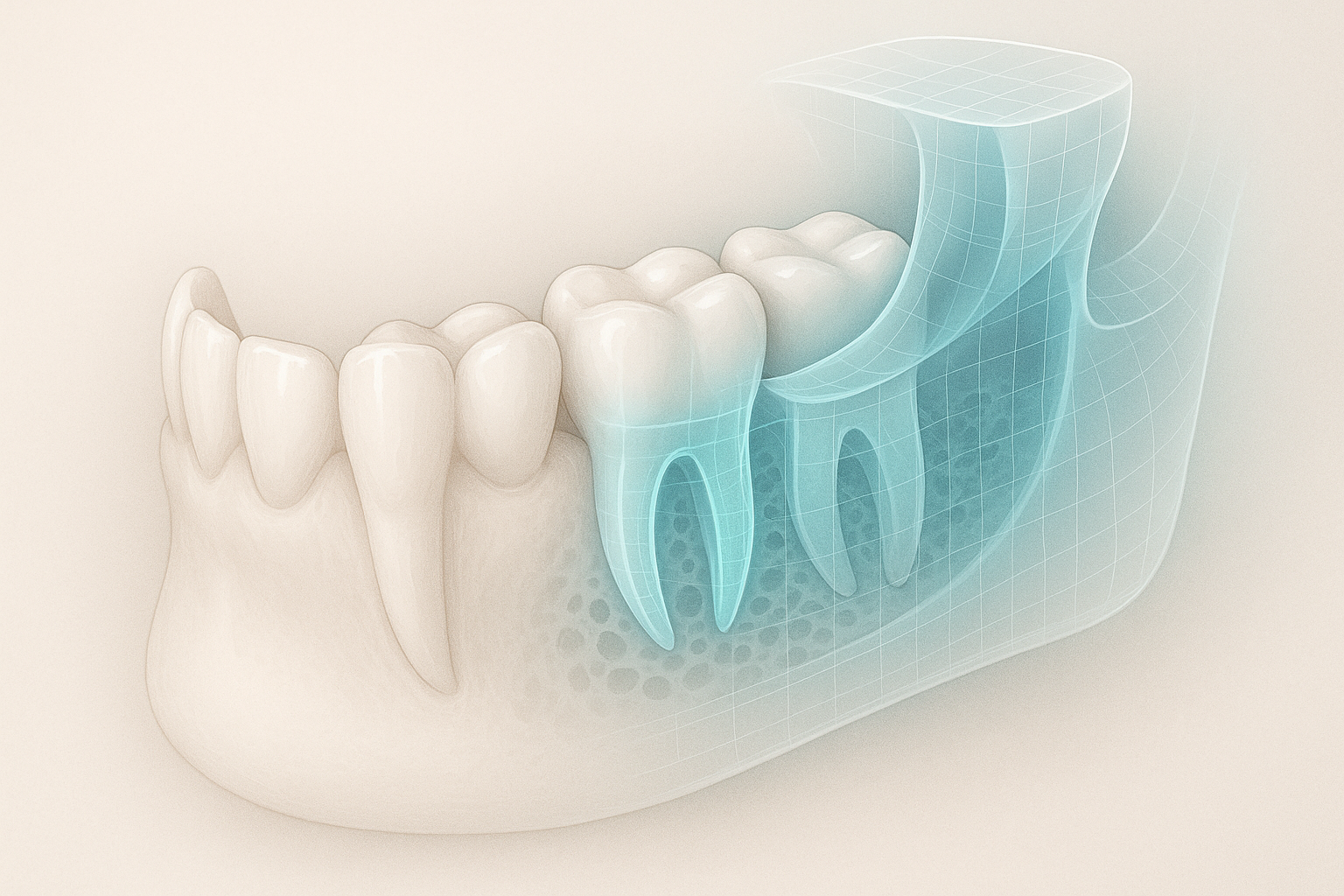
This is why we often recommend 3D Cone Beam Computed Tomography (CBCT). CBCT technology provides distortion-free, three-dimensional volumetric images of your oral structures [9]. Unlike traditional X-rays, a CBCT scan takes a single rotation around your head, capturing hundreds of images that are then reconstructed into a detailed 3D model. This offers superior accuracy and precision for assessing bone loss, especially for identifying complex defects like intra-bony craters, furcation involvements (bone loss between the roots of multi-rooted teeth), and buccal/lingual bone destruction that would be invisible on 2D images.
The precision of CBCT allows us to visualise these defects from every angle, providing the clarity needed for truly personalised treatment planning. In fact, advanced AI models, particularly Convolutional Neural Networks (CNNs), are already demonstrating high accuracy (0.76 to 0.98 for bone loss detection) in analysing these radiographs, often outperforming traditional methods.
Emerging Imaging Techniques
Beyond CBCT, the field of diagnostics is always advancing. Innovative techniques like infrared thermography are showing promise for the early, non-invasive detection of inflammation, providing even earlier indicators of periodontal disease activity.
Microbiological Analysis: Unmasking the Bacterial Culprits
Periodontal disease is fundamentally a bacterial infection. While we all have bacteria in our mouths, certain specific pathogens, often referred to as “red complex bacteria,” play a significant role in triggering and progressing the disease. Microbiological analysis of samples from your pockets help us identify the specific types and quantities of these harmful bacteria. These bacteria are the cause of periodontal disease and they can be eliminated with laser periodontal treatment such as Duo-Lase.
Advanced techniques, such as 16S rRNA analysis and metagenomics, allow us to precisely map the oral microbiome. This detailed understanding of your unique bacterial ecosystem guides our approach, allowing for targeted therapies, including specific antibiotics or antimicrobial rinses, alongside your mechanical cleaning laser periodontal treatment.
Genetic Risk Factors: Is Periodontitis in Your DNA?
Did you know that your genetic makeup can influence your susceptibility to periodontal disease? While bacteria are the direct cause, your body’s immune response to those bacteria is largely dictated by your genetics. Some individuals are genetically predisposed to an exaggerated inflammatory response to the presence of periodontal bacteria.
Research has identified specific genetic variants, such as Single Nucleotide Polymorphisms (SNPs) in genes like IL1A, IL1B, IL4, IL6, IL10, TNFA, FcγR, VDR, TLR2, TLR4, and MMP1, that are associated with an increased susceptibility to periodontitis. These genes play roles in inflammation, immune response, and tissue breakdown.
Understanding your genetic risk factors can be a powerful tool for truly personalised care. If you have a genetic predisposition, it doesn’t mean you will get severe gum disease, but it does mean you might need a more vigilant approach to prevention and maintenance. This insight allows us to proactively manage your risk and tailor preventive strategies specifically for you, aiming to mitigate the impact of your genetic makeup.
Decoding Your Diagnosis: The 2018 Staging (I-IV) and Grading (A-C) System
Once all diagnostic information is gathered – clinical measurements, advanced imaging, and consideration of any genetic factors – we use the globally recognised 2018 classification system for periodontal disease. This comprehensive system goes beyond simply saying “you have gum disease” to precisely categorising its severity, extent, and rate of progression. This precise framework is critical for creating an effective, personalised treatment plan.
Why Staging Matters: Severity, Extent, and Complexity
Staging classifies the severity and extent of your disease, along with the complexity of its management. It’s determined by factors such as:
- Clinical Attachment Loss (CAL): How much the gum has detached from the tooth.
- Radiographic Bone Loss (RBL): The amount of bone lost around the teeth, as seen on X-rays or CBCT.
- Tooth Loss: How many teeth have been lost due to periodontitis.
- Complexity Factors: Probing depths, furcation involvement, tooth mobility, and masticatory dysfunction.
The four stages are:
- Stage I (Initial Periodontitis): Characterised by early attachment loss, typically 1-2mm. Bone loss is minimal, and the disease is generally reversible.
- Stage II (Moderate Periodontitis): Established damage with attachment loss of 3-4mm. Bone loss is evident, but management is still relatively straightforward.
- Stage III (Severe Periodontitis with Potential Tooth Loss): Significant damage with attachment loss of 5mm or more. This stage often involves deep pockets, intrabony defects, furcation involvement, and may have a history of tooth loss due to periodontitis.
- Stage IV (Advanced Periodontitis): Extensive damage, severe attachment loss, and multiple tooth loss. This stage often involves hypermobility of teeth, masticatory dysfunction, and requires complex rehabilitation needs.
Why Grading Matters: Rate of Progression & Risk Factors
Grading assesses the rate of progression of your disease and identifies risk factors that influence its trajectory. This helps us understand how aggressively your disease is behaving and adjust our treatment intensity. Grade B is the default assumption, adjusted by evidence.
The three grades are:
- Grade A (Slow Progression): Minimal destruction over time, typically found in non-smokers and individuals with controlled systemic conditions like diabetes.
- Grade B (Moderate Progression): The most common grade, with a moderate rate of destruction. May involve some risk factors.
- Grade C (Rapid Progression): Indicates rapid destruction of periodontal tissues. Often associated with high-risk factors such as active smoking or uncontrolled diabetes.
Connecting Staging & Grading to Your Treatment Plan
Understanding your specific stage and grade is not just an academic exercise. It directly informs the creation of your highly personalised treatment strategy. For example, a patient with Stage I, Grade A periodontitis will have a very different treatment plan than someone with Stage III, Grade C. This precise classification allows us to predict disease behaviour, assess future risk, and select the most appropriate therapies, moving away from a one-size-fits-all approach to true precision periodontics.
From Diagnosis to Domination: Crafting Your Personalized Treatment Plan
With a comprehensive diagnosis in hand, we can then craft a treatment plan that is as unique as your smile. This isn’t about guesswork; it’s about evidence-based decisions guided by your specific stage, grade, and individual risk factors.
Tailored Therapies Based on Stage & Grade and the Microbiological Test
Treatment options range from non-surgical interventions for earlier stages to advanced surgical procedures for more complex cases:
- Non-Surgical Treatments: For Stage I and II periodontitis, initial treatment often involves scaling and root planing – a meticulous deep cleaning to remove plaque and calculus from above and below the gum line. We may also use systemic antibiotics to target specific bacteria identified in microscopic analysis. Our advanced Duo-Lase™ periodontal treatment, which uses non-surgical laser therapy, is a less invasive alternative to traditional surgery, often providing excellent results for various stages of periodontitis. Duo-Lase can treat the most aggressive form of periodontal disease without the need of painful conventional surgery like listed below. You can learn more about laser treatment for gum disease on our website.
- Surgical Treatments: For more advanced cases (Stage III and IV), especially when deep pockets or specific bone defects are present, surgical intervention may be necessary. Procedures can include:
- Flap Surgery: To access and clean root surfaces more effectively.
- Bone Grafts: To regenerate lost bone tissue around your teeth. For significant bone loss, we offer advanced bone grafting procedures.
- Guided Tissue Regeneration: To encourage the growth of new gum and bone tissue.
- Soft Tissue Grafts: To cover exposed roots and reduce sensitivity.
- Tissue-Stimulating Proteins: To promote natural tissue regeneration.
The Role of Lifestyle in Management
Regardless of your stage and grade, your commitment to daily oral hygiene and healthy lifestyle choices is paramount. Meticulous brushing and flossing, a balanced diet, smoking cessation (smoking is a major risk factor for Grade C periodontitis), and stress management all play a vital role in controlling the disease and supporting your treatment outcomes. This is not just a recommendation; it’s an integral part of managing your specific condition effectively.
Long-Term Maintenance & Monitoring
Periodontal disease is a chronic condition that requires ongoing management. After initial treatment, supportive periodontal therapy, including regular check-ups and professional cleanings, is crucial to prevent recurrence and progression. We use ongoing diagnostics to monitor your progress, ensuring your treatment plan adapts to your evolving needs and keeps your oral health in optimal condition for the long term.
Trust & Expertise: Why Choose Behrens Dental Practice for Comprehensive Care
Choosing the right dental practice for periodontal care is a significant decision. At Behrens Dental Practice, located in the heart of South Kensington, London, we combine a legacy of three generations of dental excellence with cutting-edge technology and a deeply patient-centric approach.
Dr. Ole Behrens, a third-generation dentist with a PhD in Maxillofacial Surgery, leads our team, embodying a commitment to precision and innovation. We utilise high-powered microscopes for enhanced diagnostics and treatment, ensuring unparalleled accuracy in every procedure. Our advanced Duo-Lase™ periodontal treatment, founded by Dr. Behrens himself, offers a less invasive, highly effective option for gum disease.
Our multilingual team, offering services in English, German, French, Polish, Greek, Italian, Spanish and Hindi, ensures that every patient feels comfortable and understood. We are proud recipients of the ‘Private Dentistry Awards: Team of the Year, Highly Commanded,’ and our 4.8 out of 5 rating based on 342 reviews speaks volumes about our patient satisfaction. When you choose us, you’re choosing a practice dedicated to empowering you with knowledge, advanced technology, and truly personalised care to achieve and maintain lasting oral health.
FAQs: Your Questions About Periodontal Diagnosis Answered
Can gum disease be cured?
Gingivitis, the early stage of gum disease, is reversible with proper oral hygiene and professional cleaning. However, periodontitis, which involves bone loss, cannot be “cured” in the sense of fully reversing all damage. The goal of treatment is to halt its progression, manage the infection, prevent further bone loss, and restore health. Long-term maintenance is crucial. However, with Duo-Lase a certain degree of bone regeneration can be achieved and the foundation of the tooth with be stronger again.
How long can you keep your teeth with periodontal disease?
With accurate diagnosis, personalised treatment, and diligent home care, many individuals can keep their teeth for life, even with a history of periodontal disease. The key is consistent management and adherence to your periodontist’s recommendations. With Duo-Lase we have saved many teeth that other dentists wanted to extract.
Is my life over if I have gum disease?
Absolutely not. While periodontal disease is a serious condition with implications for your overall health, an accurate diagnosis and comprehensive treatment plan can effectively manage it. It’s a journey of active management, not despair.
How accurate is the staging and grading system?
The 2018 staging and grading system is a highly accurate and globally recognised framework. It provides a standardised, evidence-based method for classifying periodontal disease, allowing dental professionals to communicate clearly and, most importantly, create highly precise and effective treatment plans tailored to each individual’s needs.
What are the latest advancements in gum disease treatment?
The field is constantly evolving. Some of the latest advancements include non-surgical laser treatments like our Duo-Lase™ technology, advanced 3D imaging (CBCT) for superior bone analysis, the use of AI in diagnostics for improved detection of bone loss, and the growing understanding of specific genetic markers and biomarkers for personalised treatment approaches.