
Custom Smile Makeovers Tailored for Chelsea Lifestyles
There is a pervasive myth in the world of cosmetic dentistry that a “perfect” smile means blinding white perfection—a uniform row of teeth that announces itself the moment you walk into a room. However, for the discerning residents of Chelsea, true perfection is far more nuanced. It is not about looking different; it is about looking like the best, most vibrant version of yourself.
In our community, the most successful aesthetic work is the work no one notices. It is the restoration of confidence that allows you to command a board meeting or enjoy a gala dinner without a second thought about your appearance. When seeking a dentist or dental care in Chelsea, London, the objective shifts from simple “fixing” to high-performance lifestyle enhancement. This guide explores the architectural approach to smile design—where art meets engineering to create results that are as discreet as they are transformative.
The Chelsea Standard: Why “One-Size-Fits-All” Fails
We have all seen the “Turkey Teeth” phenomenon—smiles that look manufactured, opaque, and entirely disconnected from the person’s natural features. While this may appeal to a specific social media demographic, it rarely aligns with the professional and social requirements of established London life.
The “Chelsea Standard” of dentistry is defined by bespoke artistry. It rejects the cookie-cutter template in favour of facial harmony. A smile makeover shouldn’t just change your teeth; it should balance your facial features, support your lip line, and even soften the appearance of ageing.
This approach requires moving beyond the concept of “buying veneers” to understanding the architecture of your face. It is not just a dental procedure; it is a curated lifestyle solution designed to withstand the scrutiny of high-definition cameras and intimate social settings alike.
The Architecture of a Smile: The Science of Harmony
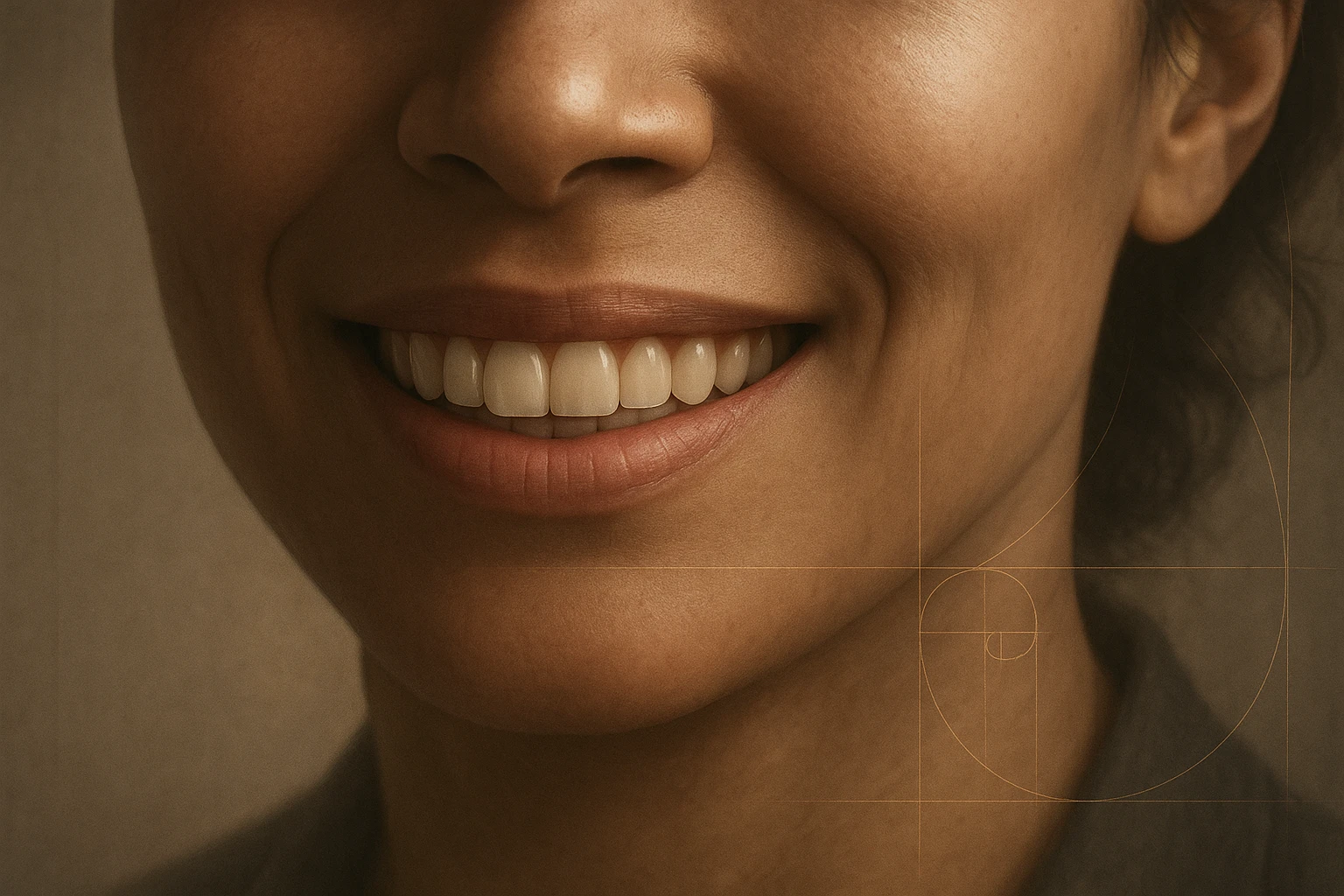
To understand how a bespoke smile is constructed, we must look at the mathematics of beauty. The human eye is naturally drawn to symmetry and proportion, specifically the “Golden Ratio” (1.618:1). This mathematical concept, used in everything from the Parthenon to Renaissance art, is also the secret to a naturally beautiful smile.
The Role of Facial Typology
Your teeth must speak the same language as your face shape. A skilled aesthetic dentist acts much like an architect, considering the “site conditions” before laying the first brick.
- Square Faces: Often benefit from softer, more rounded tooth edges to reduce severity.
- Ovoid Faces: Can be balanced with slightly more angular, dominant central incisors to add definition.
- Tapered Faces: May require a broader arch to provide better lip support and fill the “buccal corridors” (the dark spaces in the corners of a smile).
By adhering to these architectural principles, we ensure that the result feels organic—as if you were born with that smile, rather than having acquired it.
The “Frame Theory”: Why Gums Dictate Aesthetics
Imagine buying a masterpiece painting and placing it in a cracked, warped frame. The artwork loses its value. In dentistry, your gums are the frame. You can have the most exquisite ceramic work in the world, but if the periodontal health surrounding it is compromised, the aesthetic will fail.
This is where the distinction between a cosmetic shop and a comprehensive clinical practice becomes clear. A focus on periodontal health—the foundation of your teeth—is non-negotiable for longevity.
The Synergy of Health and Beauty
Inflamed, uneven, or receding gums can make even straight teeth look aged or unhealthy. Advanced approaches, such as periodontal maintenance, ensure that the soft tissue creates a symmetrical, pink, and healthy scallop around each tooth.
At Behrens Dental Practice, we often find that the secret to a younger-looking smile isn’t just in the white aesthetics (the teeth), but in the pink aesthetics (the gums). Utilizing advanced technology like laser therapy allows us to sculpt this “frame” with minimal invasiveness, ensuring the foundation is as strong as the restoration.
The “Discreet” Menu: Materials and Methods
Modern aesthetic dentistry offers a spectrum of solutions, ranging from non-invasive polishing to complete ceramic reconstruction. Choosing the right path depends on your timeline, your lifestyle, and the current state of your oral health.
Composite Bonding: The Immediate Refresh
For those seeking an immediate improvement with zero “social downtime,” composite bonding teeth is often the answer. This involves applying a high-grade resin directly to the tooth to fix chips, close gaps, or improve shape.
- Pros: Usually completed in one visit; requires little to no removal of natural tooth structure.
- Cons: Material is more porous than porcelain, meaning it may stain over time (coffee, red wine) and typically requires polishing every few years.
Porcelain Veneers: The Long-Term Investment
When structural changes or permanent colour correction are required, porcelain veneers offer the gold standard. Modern ceramics mimic the light-reflecting properties of natural enamel—translucency, opalescence, and fluorescence.
- Pros: Highly resistant to staining; incredibly durable; mimics natural teeth perfectly.
- Cons: requires a short preparation phase and a waiting period for the ceramics to be hand-crafted.
Deciding between these options often comes down to the “Subtlety Scale”—balancing the desire for a permanent change against the need for non-invasive treatment.
The “Test Drive”: Removing the Fear of Regret
The biggest barrier to aesthetic dentistry is the fear of the unknown. “What if I don’t like it?” “What if it looks fake?”
We eliminate this anxiety through Digital Smile Design (DSD). Before any clinical work begins, we use high-resolution imagery and digital mapping to design your new smile on a screen.
The Mock-Up Phase
Taking it a step further, we can often create a temporary “mock-up” in your mouth. This allows you to essentially “test drive” your new smile. You can see how it looks when you speak, smile, and laugh. This collaborative process ensures that the final result is exactly what you envisioned—a veneer smile that feels entirely your own.
The High-Performance Path: Integrating Care into Your Life
For the busy Chelsea professional, time is a currency as valuable as money. A smile makeover should not disrupt your life. By leveraging technologies like high-powered microscopes for precision and digital scanners for comfort, we streamline the process.
From the initial consultation to the final reveal, the journey is designed to be efficient. Whether you are preparing for a wedding, a career milestone, or simply investing in yourself, the process is managed with the discretion and professionalism you expect from a top-tier medical practice.
Frequently Asked Questions
Will my new smile look fake?
Not if it is designed correctly. The “fake” look usually comes from teeth that are too opaque (monochromatic white) or too large for the face. By using layered porcelain that mimics the translucency of natural enamel and adhering to the Golden Ratio for your specific facial features, the result should be undetectable to the untrained eye.
What is the difference between a dentist and an aesthetic specialist?
While many dentists offer cosmetic services, achieving high-end results requires a deep understanding of facial aesthetics and material science. Practices that employ lecturers or dental surgeons with advanced degrees (such as a PhD or MSc) bring an academic level of rigour to the artistic process, ensuring results that are both beautiful and biologically sound.
How do I maintain my aesthetic work?
Maintenance is similar to natural teeth but requires diligence. Regular periodontal cleaning is vital to ensure the gums remain healthy around the restorations. For composite bonding, avoiding habits like biting nails or opening packaging with teeth is crucial to prevent chipping.
Can I fix gum recession as part of my makeover?
Yes. Often, “long teeth” caused by recession can be addressed. Advanced treatments, including laser periodontal treatment London, can help manage gum health and improve the overall aesthetic frame of your smile, often with less discomfort than traditional surgery.
How long does the process take?
Composite bonding can often be completed in a single afternoon. Porcelain veneers typically require two to three visits over the course of a few weeks to allow for the custom fabrication of the ceramics by master technicians.
Taking the Next Step
Your smile is your most enduring accessory. It is the first thing people notice and the last thing they remember. Understanding the options available—from the biology of your gums to the geometry of your face—is the first step toward a transformation that enhances not just your appearance, but your quality of life.
If you are considering a change, look for a partner who prioritizes education and precision over speed. After all, true luxury in dentistry is a result that looks like you were simply born with it.