

Guide to New Periodontal Staging and Grading System
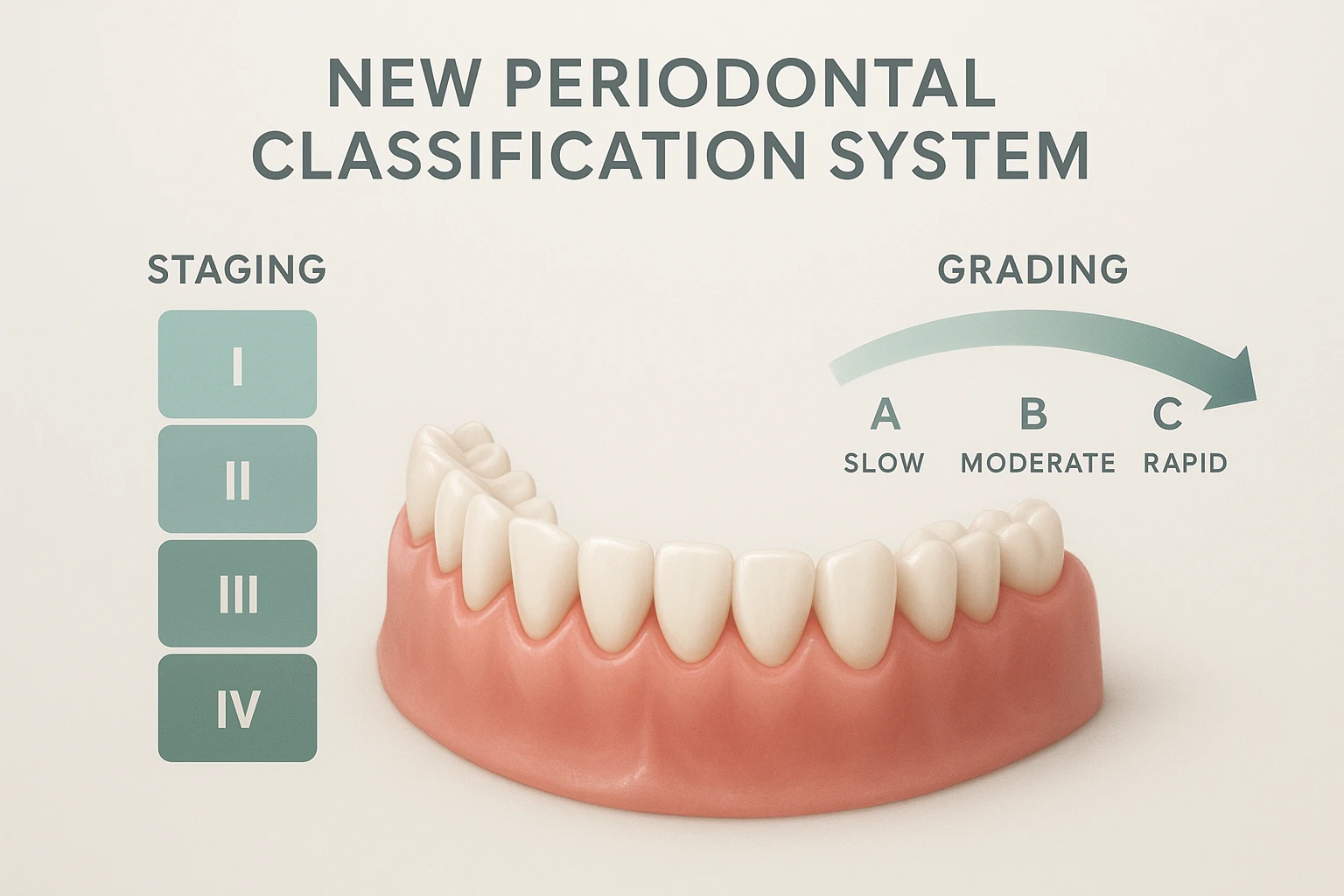
Have you ever been told you have ‘a bit of gum disease’ and been left wondering what that truly means? It’s a vague diagnosis that can leave you feeling uncertain and a little worried. Is it serious? Is it reversible? What happens next? For years, dental professionals used broad terms like “chronic” or “aggressive” periodontitis, which offered some information but lacked the precision needed for truly personalized care.
This ambiguity is precisely why the global dental community came together. In 2018, the American Academy of Periodontology (AAP) and the European Federation of Periodontology (EFP) introduced a groundbreaking new classification system. This isn’t just a reshuffling of old terms; it’s a complete paradigm shift in how we understand, diagnose, and treat periodontal disease.
Think of it as moving from a blurry, black-and-white photograph of your gum health to a high-definition, multi-dimensional map. This new system uses a framework of Staging and Grading to give you and your dentist a crystal-clear picture of not only what’s happening in your mouth right now, but also where your health is headed. It’s a tool that empowers you with knowledge and enables your dental team to create a treatment plan tailored specifically to you.
Why a New System? Moving Beyond ‘Chronic’ vs. ‘Aggressive’
The previous classification system, which had been in use for nearly two decades, largely categorised periodontitis into two main buckets: “chronic” (slow-moving, often associated with age and plaque) and “aggressive” (rapidly progressing, often in younger individuals).
While this was useful, it had significant limitations:
- It was often a one-size-fits-all approach. Two people with “chronic” periodontitis could have vastly different clinical situations and future risks.
- It didn’t fully account for systemic health. We now know that conditions like diabetes and lifestyle factors like smoking have a profound impact on gum health. The old system didn’t formally integrate these critical risk factors.
- The distinction wasn’t always clear. The lines between “chronic” and “aggressive” could blur, leading to inconsistencies in diagnosis and treatment planning across different practices.
The 2018 AAP/EFP classification system was designed to solve these problems. It provides a unified, global language for clinicians, ensuring that a diagnosis in London means the same thing as a diagnosis in New York or Tokyo. Most importantly, it creates a multidimensional framework that considers severity, complexity, and individual risk to build a complete patient profile.
Staging vs. Grading: The Two Key Pillars of Modern Gum Health Diagnosis
At the heart of the new system are two fundamental concepts: Staging and Grading. People often confuse them, but they answer two very different—and equally important—questions about your health.
To create a clear “aha moment,” let’s use an analogy from general medicine that many people are familiar with: cancer classification.
- Staging answers the question: “Where are we now?” It assesses the current severity and extent of the disease. It’s a snapshot of the damage that has already occurred and the complexity of managing the condition.
- Grading answers the question: “Where are we headed?” It assesses the risk of future progression. It’s a predictive tool that looks at the biological evidence of the disease’s past behaviour and incorporates risk factors to forecast its speed.
So, Staging tells us how serious the disease is today. Grading tells us how likely it is to get worse in the future. By combining both, your dental team gets a comprehensive understanding that guides every single treatment decision.

A Deep Dive into Staging (I-IV): How Severe is the Disease?
Staging defines the severity of periodontitis based on clinical attachment loss (CAL)—the primary measure of tissue destruction—as well as the complexity of managing the case. This includes factors like tooth loss due to periodontitis, pocket depth, bone loss patterns, and involvement of the furcation (the area where the roots of multi-rooted teeth divide).
Each stage represents a more advanced state of the disease. A detailed look at the periodontal disease diagram can help visualize the structures involved.
Stage I: Initial/Mild Periodontitis
This is the earliest and least severe form of the disease.
- Clinical Picture: You’ll see early signs of bone loss (1-2 mm of CAL). The pockets around the teeth are still relatively shallow (generally ≤4 mm), and there’s no tooth loss due to gum disease. The bone loss is primarily horizontal.
- What it Means: The foundational support for your teeth has just begun to erode. At this stage, the disease is highly manageable with professional care and improved home hygiene. The goal is to halt progression and prevent it from ever reaching Stage II.
Stage II: Moderate Periodontitis
Here, the destruction is more established and noticeable.
- Clinical Picture: The clinical attachment loss is more significant (3-4 mm). Pocket depths are starting to increase (generally ≤5 mm), but tooth loss due to the disease is still not a factor. The bone loss remains mostly horizontal.
- What it Means: The damage is now moderate. The complexity of treatment is still relatively low, but it’s a clear signal that the disease is active and requires a dedicated effort to control. Halting it here is crucial to prevent more complex issues from developing.
Stage III: Severe Periodontitis with Potential for Tooth Loss
This stage marks a significant turning point where the disease begins to seriously compromise your dental health and function.
- Clinical Picture: The damage is severe, with ≥5 mm of CAL and pocket depths of 6 mm or more. This stage is also defined by having lost up to 4 teeth due to periodontitis. You may see more complex issues like vertical bone loss and furcation involvement (Class II or III).
- What it Means: The structural support for your teeth is severely weakened. There’s a real risk of losing more teeth if the disease isn’t aggressively managed. Treatment becomes more complex and may involve more advanced procedures to save the remaining teeth. Understanding the full risks of periodontal disease becomes critically important at this stage.
Stage IV: Severe Periodontitis with Potential for Loss of All Teeth
This is the most advanced stage, where the disease has caused widespread damage that significantly impacts your ability to chew and your overall quality of life.
- Clinical Picture: This stage includes all the criteria of Stage III, but is further complicated by having lost 5 or more teeth due to periodontitis. It often involves significant bite collapse, tooth drifting, and fewer than 20 remaining teeth. The masticatory (chewing) function is severely compromised.
- What it Means: The damage is so extensive that a full-mouth rehabilitation is often necessary. The focus of treatment is not just on stopping the disease but also on restoring function, which may involve a combination of periodontal therapy, orthodontics, and extensive restorative work like dental implants.
Understanding Grading (A-C): How Fast is it Progressing?
While Staging gives us a snapshot of the present, Grading provides the forward-looking, dynamic element of the diagnosis. It helps predict the likely rate of progression by looking at direct and indirect evidence of the disease’s history and incorporating powerful risk modifiers.
The default assumption for any patient is Grade B. The clinician then looks for evidence to shift them to Grade A (slower risk) or Grade C (higher risk).
Grade A: Slow Progression
This grade indicates a low risk of future progression. The disease is moving very slowly, if at all.
- Evidence: No evidence of bone loss or attachment loss over a 5-year period. The patient often has heavy plaque deposits but surprisingly low levels of tissue destruction. This suggests their body has a strong and resilient immune response.
- Risk Factors: The patient is a non-smoker and does not have diabetes.
- What it Means: Your prognosis is excellent. While you still need to manage the disease, your body is naturally well-equipped to keep it in check with proper professional support and home care.
Grade B: Moderate Progression
This is the expected rate of progression and serves as the baseline for all patients.
- Evidence: Evidence of less than 2 mm of bone or attachment loss over a 5-year period. The level of destruction is consistent with the amount of plaque and calculus present.
- Risk Factors: The patient smokes fewer than 10 cigarettes per day and/or has well-controlled diabetes (HbA1c <7.0%).
- What it Means: The disease is progressing at an anticipated rate. This is a call to action. With standard treatment and good management of risk factors, the disease can be effectively controlled. The goal is to prevent the patient from ever tipping into Grade C. A proper understanding of the periodontitis grade is key to tailoring the right therapeutic approach.
Grade C: Rapid Progression
This grade is a red flag, indicating a high risk of rapid future progression and a less predictable treatment outcome.
- Evidence: Evidence of 2 mm or more of bone or attachment loss over a 5-year period. The rate of destruction is very high relative to the amount of plaque present—meaning the disease is progressing much faster than would be expected.
- Risk Factors: The patient smokes 10 or more cigarettes per day and/or has poorly controlled diabetes (HbA1c ≥7.0%).
- What it Means: Your body’s response to the bacterial challenge is heightened, leading to rapid tissue breakdown. The prognosis is more guarded, and treatment needs to be more intensive. Aggressive management of both the periodontal disease and the contributing risk factors (like quitting smoking or improving diabetic control) is absolutely essential.

Bringing It All Together: What Your Diagnosis Means for Your Treatment
This is where the power of the new system truly shines. A diagnosis is no longer just a label; it’s a detailed blueprint for action.
Imagine two patients. Under the old system, both might have been diagnosed with “severe chronic periodontitis.”
- Patient A is diagnosed as Stage III, Grade B. This tells us they have severe existing damage (Stage III) but it’s progressing at a moderate, predictable rate (Grade B). The treatment plan will be robust, focusing on halting the disease and managing the existing complexity.
- Patient B is diagnosed as Stage III, Grade C. This tells us they have the same level of severe damage (Stage III), but their disease is on a much more aggressive and rapid trajectory (Grade C), likely fueled by smoking or uncontrolled diabetes. This patient needs more intensive therapy, more frequent monitoring, and a co-ordinated approach with their medical doctor to manage the systemic risk factors.
This level of detail allows for truly personalized periodontal treatment. It helps clinicians determine the intensity of therapy, the frequency of maintenance visits, and whether innovative approaches like laser treatment for gum disease might be beneficial to achieve better control.
What About Dental Implants? Peri-Implant Diseases in the New System
The 2018 classification also, for the first time, provides a clear and comprehensive framework for diseases affecting dental implants. This was a critical addition, as millions of people now rely on implants to restore their smiles.
- Peri-implant mucositis: This is the equivalent of gingivitis for an implant. It’s reversible inflammation of the soft tissues around the implant without any bone loss.
- Peri-implantitis: This is the equivalent of periodontitis. It involves inflammation and progressive bone loss around an implant, which can lead to its failure if left untreated.
By classifying these conditions, the system ensures that the health of dental implants is monitored with the same rigour as natural teeth. When considering tooth replacement, it is vital to understand what is an implant and how to care for it long-term.
Frequently Asked Questions (FAQ)
What’s the main difference between staging and grading again?
The simplest way to remember is: Staging is about severity (how bad is it now?). Grading is about risk (how fast is it likely to get worse?).
Does everyone with gum disease get a Stage and Grade?
The Staging and Grading system is specifically for periodontitis—the more advanced form of gum disease that involves bone loss. The earlier stage, gingivitis, is characterized by inflammation without bone loss and is classified separately. If you have periodontitis, you should receive a Stage and a Grade.
Can my Stage or Grade change over time?
This is an excellent question. Your Stage describes the amount of damage that has already occurred. Since lost bone and attachment don’t typically grow back, your Stage generally will not go down. A successfully treated Stage IV patient is still a Stage IV patient, but one who is now stable and well-maintained. Your Grade, however, is dynamic and can be improved. By quitting smoking or getting your diabetes under excellent control, you can potentially move from a Grade C to a Grade B, significantly improving your long-term prognosis.
Is gum disease genetic?
Genetics can certainly play a role in your susceptibility. Some people are genetically more prone to a strong inflammatory response to plaque bacteria. This is one of the factors considered in the grading process. If you’re wondering, “is gum disease hereditary,” the answer is that while it isn’t directly inherited like eye colour, your genetic makeup can be a significant risk factor.
How does this new system help me as a patient?
It empowers you. Instead of a confusing label, you get a clear, detailed explanation of your condition. It helps you understand the seriousness of your disease and the specific factors influencing it. This clarity facilitates better conversations with your dental team and makes you an active partner in your own care.
Your Path to Understanding and Managing Your Gum Health
The new AAP/EFP classification system is more than just an academic exercise for dentists; it is a fundamental leap forward in patient care. It replaces ambiguity with precision, enabling clinicians to diagnose with greater accuracy, predict the future course of the disease, and personalize treatment plans like never before.
For you, the patient, it offers clarity and a sense of control. Understanding your Stage and Grade helps you grasp the importance of treatment and the critical role that managing risk factors like smoking and diabetes plays in securing your long-term dental health.
The first step on this path is a comprehensive assessment from a dental team that is deeply invested in patient education and uses the latest diagnostic principles. If you are in London and want to gain a true understanding of your gum health, our team at Behrens Dental Practice is committed to providing that clarity, helping you navigate your treatment journey with confidence.